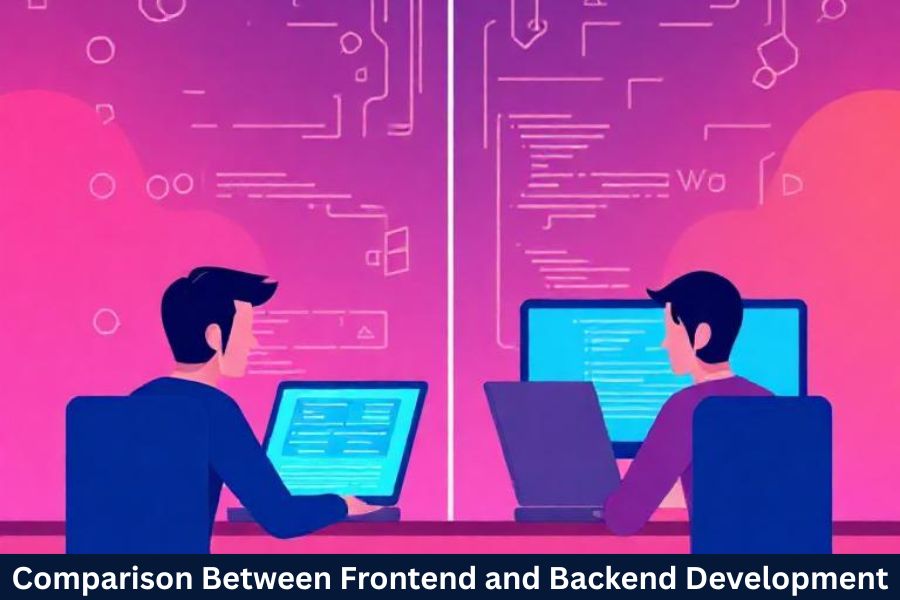
When you browse a website or use an application, there are two major components at play behind the scenes: frontend and backend development. Each of these plays a distinct role in how a website or app functions, feels, and interacts with users. But what exactly is the difference between frontend and backend development, and how do these two areas work together to create a seamless user experience?
In this article, we’ll dive into a detailed comparison of frontend vs backend development and explore their unique roles, challenges, tools, and technologies. Whether you’re a developer, a tech enthusiast, or someone looking to break into web development, understanding these differences is key to mastering the field.
What is Frontend Development?
Frontend development is the part of web development that users interact with directly. It’s everything that you see and use on a website or web app. From buttons and navigation bars to fonts and colors, frontend developers are responsible for creating and optimizing the visual elements of a website or application.
Key Responsibilities in Frontend Development:
- Designing and implementing visual elements of a website.
- Ensuring responsiveness and cross-browser compatibility.
- Improving user experience (UX) through interaction design and performance optimization.
Technologies Used in Frontend Development:
Frontend developers typically work with languages like:
- HTML (HyperText Markup Language) – The skeleton of the web, defining the structure of web pages.
- CSS (Cascading Style Sheets) – Used to style the HTML elements, such as fonts, colors, and layouts.
- JavaScript – The scripting language that adds interactivity, animations, and dynamic behavior to the website.
What is Backend Development?
Backend development refers to the server-side of web development—the part of a website that users don’t see. It handles everything that happens “under the hood” to support the frontend. Backend developers create and manage the logic, databases, authentication, and server configurations that make websites and applications function properly.
Key Responsibilities in Backend Development:
- Designing and maintaining databases to store and retrieve data.
- Writing server-side logic to ensure smooth user requests and responses.
- Ensuring website scalability, security, and performance.
Technologies Used in Backend Development:
Backend developers work with various programming languages and frameworks such as:
- Node.js (JavaScript runtime) – Popular for building scalable server-side applications.
- Python (Django, Flask) – Known for its simplicity and powerful frameworks.
- Ruby (Ruby on Rails) – A framework that makes it easier to build database-driven websites.
- Java (Spring, Hibernate) – Used in large-scale applications for its performance and scalability.
Key Differences Between Frontend and Backend Development
Role and Focus
- Frontend is user-focused, concerned with creating the user interface and ensuring smooth interaction with the website or app.
- Backend is system-focused, ensuring that data flows smoothly from the server to the frontend and that the business logic works seamlessly.
Skills and Tools
- Frontend developers are skilled in languages like HTML, CSS, and JavaScript, and tools like Adobe XD or Figma for designing interfaces.
- Backend developers focus on databases, server management, and API design, working with technologies like Node.js, Python, or Java.
Languages Used
- Frontend: HTML, CSS, JavaScript.
- Backend: Python, Java, Ruby, PHP, Node.js.
Frontend vs Backend: Workflow and Collaboration
Frontend and backend developers rarely work in isolation. In fact, they need to collaborate closely to ensure that the application functions as expected. Frontend developers often rely on APIs (created by backend developers) to pull data and display it in a user-friendly way. Meanwhile, backend developers depend on frontend designs to structure their databases and logic effectively.
Common Tools for Collaboration:
- APIs (Application Programming Interfaces): Allow frontend and backend developers to communicate and exchange data.
- Version Control (Git): Helps both teams manage changes in code and collaborate more effectively.
Common Frameworks in Frontend Development
Popular Frontend Frameworks:
- React.js – A JavaScript library that allows developers to build interactive user interfaces efficiently.
- Angular – A robust framework developed by Google, often used for single-page applications.
- Vue.js – A progressive framework known for its simplicity and flexibility in building user interfaces.
Each of these frameworks helps frontend developers build dynamic, responsive, and performant websites.
Common Frameworks in Backend Development
Popular Backend Frameworks:
- Node.js – A JavaScript runtime environment that allows for scalable server-side development.
- Django – A Python-based framework known for its ease of use and security features.
- Ruby on Rails – A full-stack framework that emphasizes convention over configuration.
These frameworks help backend developers streamline their workflows and build robust applications.
Frontend and Backend Security Considerations
Security is critical for both frontend and backend development, but they handle it differently.
Frontend Security:
- Preventing cross-site scripting (XSS) attacks.
- Ensuring secure data input from users to prevent malicious entries.
- Implementing SSL/TLS encryption to protect user data.
Backend Security:
- Managing data encryption at rest and during transmission.
- Protecting APIs from unauthorized access and attacks.
- Ensuring user authentication and authorization.
Frontend and Backend Development Challenges
Both frontend and backend developers face unique challenges. Frontend developers must deal with browser compatibility, device responsiveness, and performance issues. Meanwhile, backend developers must ensure server uptime, optimize database performance, and prevent security breaches.
Performance Optimization in Frontend vs Backend
Frontend Optimization:
- Minimize image sizes and scripts to improve load times.
- Implement lazy loading for images and content.
- Use CDNs to deliver content faster.
Backend Optimization:
- Optimize database queries and server response times.
- Use caching to reduce load on the server.
- Implement load balancing to distribute traffic efficiently.
User Experience (UX) vs Server-Side Logic
While frontend development is focused on user experience (UX), backend development ensures the server-side logic works smoothly, making sure that everything happens as expected when users interact with the application.
Career Path and Salary Differences
Frontend and backend developers have distinct career paths. Frontend developers often advance into UX/UI design roles, while backend developers might move into full-stack development or system architecture.
Salary Comparison:
Typically, backend developers earn slightly more due to the complexity of the tasks involved, but this varies based on experience, location, and company size.
The Future of Frontend and Backend Development
The future of web development will likely see more convergence between frontend and backend technologies, with full-stack developers gaining popularity. Emerging trends like serverless architecture, microservices, and cloud-based frameworks will continue to shape the landscape.
Conclusion
Frontend and backend development are both essential to building robust, functional, and visually appealing websites and applications. While frontend focuses on the user interface and user experience, backend ensures server-side logic and data management. Together, they form the backbone of modern web development. Whether you prefer to work on the creative side with frontend or enjoy building robust server-side systems with backend, there’s a place for you in this exciting field.
FAQs
1. What is the main difference between frontend and backend development?
Frontend development deals with the user interface and user experience, while backend development handles the server-side logic and database management.
2. Which programming languages are used in frontend and backend development?
Frontend developers use HTML, CSS, and JavaScript, while backend developers use languages like Python, Ruby, Java, and Node.js.
3. Can I become a full-stack developer?
Yes, many developers become full-stack developers, mastering both frontend and backend skills to create complete web applications.
4. Which one is more challenging: frontend or backend?
It depends on your skills and interests. Frontend development requires an eye for design, while backend development requires problem-solving skills related to logic, databases, and server management.
5. Are there frameworks for both frontend and backend development?
Yes, frontend frameworks like React and Angular, and backend frameworks like Django and Node.js, are widely used to streamline the development process.

Can you be more specific about the content of your article? After reading it, I still have some doubts. Hope you can help me.
Thank you for your sharing. I am worried that I lack creative ideas. It is your article that makes me full of hope. Thank you. But, I have a question, can you help me?
Your point of view caught my eye and was very interesting. Thanks. I have a question for you.
Can you be more specific about the content of your article? After reading it, I still have some doubts. Hope you can help me.
I don’t think the title of your article matches the content lol. Just kidding, mainly because I had some doubts after reading the article.
Thank you for your sharing. I am worried that I lack creative ideas. It is your article that makes me full of hope. Thank you. But, I have a question, can you help me? https://accounts.binance.info/es-AR/register-person?ref=UT2YTZSU
I don’t think the title of your article matches the content lol. Just kidding, mainly because I had some doubts after reading the article.
I don’t think the title of your article matches the content lol. Just kidding, mainly because I had some doubts after reading the article. https://www.binance.info/register?ref=IXBIAFVY
Can you be more specific about the content of your article? After reading it, I still have some doubts. Hope you can help me. https://www.binance.info/en-NG/register?ref=YY80CKRN
Thank you for your sharing. I am worried that I lack creative ideas. It is your article that makes me full of hope. Thank you. But, I have a question, can you help me?